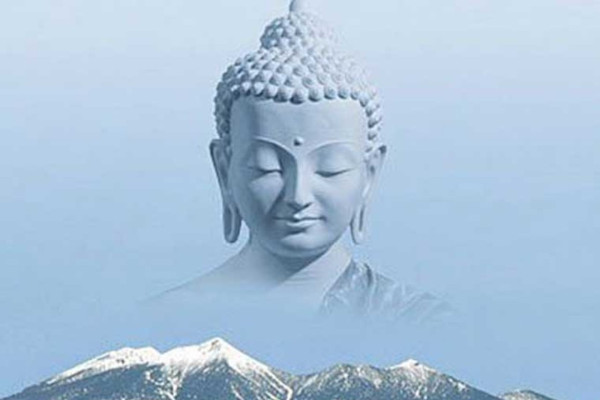
At one time, the Buddha was at the Jeta Grove in Sravasti, together with two thousand and five hundred Bhikshus and thirty-eight thousand Bodhisattvas Mahasattvas.
One day, the Buddha, together with His disciples, walked to the southern part of the city. Suddenly, they came upon a pile of bones by the roadside. Immediately, The World Honoured One bowed down to make obeisance to the bones respectfully.
When His disciples saw that, they were puzzled, "Why did The World Honoured One bow to the bones?" Venerable Ananda put his palms together and asked the Buddha, "World Honoured One! You are the Great Teacher of the Three Realms. You are the kind Father of all sentient beings. You are greatly revered by the people in the world and you are held in high esteem by us!"
"Please tell us the reason for making obeisance to this pile of bones. What are the causes and conditions behind it?" The Buddha told Ananda compassionately, "Good question indeed, Ananda! All of you are my foremost disciples and have been cultivating for a long time but there are things which you may not understand yet."
"This pile of bones could have been the bones of our ancestors, or they might have been the bones of our parents from many past lives. How can a man not pay respect to his parents? That is why I bowed respectfully to them."
The Buddha continued to say, "Ananda, now you can divide the bones into two parts. If the bones belonged to a man, they would be white and heavy. But, if they belonged to a woman, they would be dark and weigh less."
Venerable Ananda then asked the Buddha, "World Honoured One! This is what I cannot understand. In this world, a man is dressed differently from a woman. He adorns himself with robes, belts, shoes, hats and other fine attire so that we can identify him as a male at a glance.
A woman will adorn her body with powder, cosmetics and perfume. Just by looking at her dressing, we know that she is a lady! But when they are dead, only the bones remain. There is not much difference in those bones. How can we differentiate them?"
The Buddha said seriously, "If a man always goes to the temple to listen to explanations of the Sutras and Precepts, makes obeisance respectfully to the Triple Gem — Buddha, Dharma and Sangha, and recites the Buddha’s name diligently, upon his death, he will have bones which are as white as jade and are heavy."
“As for a woman, if she were to be immersed in love and emotions while she was alive, did not listen to the Sutras or make obeisance respectfully to the Buddha, and felt that her sole duty was to give birth, nurture children, and breast-feed them, how could she not get weak, thin and haggard because the milk was transformed from her blood? Besides, every child needs more than eight stones of milk for his growth."
"That is why after her death, her bones are darker and lighter." When Ananda heard that, he felt such great pain in his heart, just as though he was being stabbed with a knife. He cried sorrowfully and asked, "World Honoured One! How can I repay the virtuous kindness of my mother?"
The Buddha told Ananda, "Listen carefully! A pregnant woman has to endure ten months of suffering. During the first month of pregnancy, the life of a foetus is as precarious as a dew drop on the grass, which has condensed at dawn and might disappear by mid-day. During the second month, the embryo congeals like a piece of curd."
"During the third month, it is like a piece of coagulated blood. During the fourth month, the foetus gradually assumes a slightly human form. During the fifth month, the vital organs such as the head, two hands and two legs are formed.
During the sixth month, the essence of the six senses are developed. They are the eyes, ears, nose, tongue, body and mind. During the seventh month, the three hundred and sixty bones and joints are formed.
Besides, the eighty-four thousand hair pores are formed. During the eighth month, the brain is almost fully formed and is endowed with mind-consciousness and knowing faculty. After that, the nine apertures on the body are opened. They are the two eyes, two ears, two nostrils, a mouth, the anus and the urethra."
"When the foetus is nine months old, it often kicks and struggles in the womb, just like the vibration of Mount Sumeru. The mother can seldom get a good sleep, neither can she eat properly. From the first moment when the foetus comes into being until the moment it is born into the world, it gets its nutrients by feeding on its mother’s blood."
"On reaching the tenth month, all the vital organs are fully developed. The foetus is ready to be born. After carrying the foetus for ten months, the mother has undergone immense suffering. In order to ease the birth of her baby, the mother’s blood flows out like a river!
In a smooth delivery, the baby will flow along with the blood and emerge with the four limbs curling inwards and its head facing downwards, without causing any injury to its mother.
"But in a difficult delivery, the baby will kick and struggle its way out, and hence causing great pain to its mother. It is as if the mother's body is cut by a thousand knives and the heart is pierced by ten thousand arrows. The mother's agony is really appalling. As children, we should never forget the suffering our mother went through when she gave birth to us. Otherwise, we will be worse than animals."
Our kind mother had endured immense suffering during the process of delivery. If we were to go into details, there were at least ten types of deep kindness which were bestowed upon us by her.
The first verse of praise on the virtuous kindness of protecting the foetus — The weight of the foetus increases daily. The mother feels as though she is carrying a lofty mountain.The foetus kicks and moves about in the womb. The mother is never at ease as she feels as though she is undergoing the fury of earthquakes and windstorms.
The second verse of praise on the deep kindness of enduring suffering on the verge of delivery. After carrying the foetus for the full ten months, she is going to deliver the child.
Every morning, the mother feels as though she is seriously sick. She feels sluggish and drowsy. Her worries and fears are indescribable. She gets very anxious about the baby and cries whenever she thinks about the safety of the baby.
The third verse of praise on the kindness in forgetting her suffering after the delivery — as she has exhausted her energy in delivering the child, she feels as if all her internal organs are being torn apart . After surviving such an agonising experience, on awakening, her first thought is to enquire after her child.
The fourth verse of praise on the kindness of swallowing the bitter taste while giving the delicacies — The kindness of parents is deeper than the sea. With unbounded love and concern, they take care of their children throughout the day and night! Parents are comforted when their children are warm, full and happy. They do not mind enduring the sufferings of hunger and cold themselves.
The fifth verse of praise on the virtuous kindness of shifting her child to a dry and comfortable position while she remains at the wet spot — The loving mother takes meticulous care of her child. At night, when the child wets the bed, the mother will quickly move the child to a dry place while she remains at the cold and wet position without any grumbles! As long as her child can sleep in comfort, she does not mind her own discomfort.
“The sixth verse of praise on the deep kindness in breast-feeding and nurturing the child — The kind mother resembles the great earth which supports and nurtures the myriad forms of life.
The stern father resembles the vast sky which protects and nurtures all living beings under its shelter. The father’s love for his children is the same as the mother’s.
The seventh verse of praise on the loving kindness of washing away the filth — Mother was once a beautiful lady with a well-adorned body and a pretty face which was comparable to a cottonrose hibiscus. However, for the sake of her children, she so overworked herself that her beautiful looks were lost and she became old and haggard. Her hands which were originally smooth and soft are now rough and covered with wounds and cuts due to too much washing for her children.
The eighth verse of praise on the deep kindness of thinking of her child who has to travel afar — The mother is sad as she is separated from the child by great distances. Day and night, the parents always think of their child. They pray to the Buddha and Bodhisattva to protect the child, hoping that the child will come back safely as soon as possible.
Some children just leave their homes for many years without sending any messages to their parents. The old parents are drowned in tears day and night, looking forward earnestly to the return of the child.
The ninth verse of praise on the deep kindness of understanding and sympathising with their children — When a child has to go on a journey, the kind mother’s thoughts are always with the child, worried that the child may not be able to endure the cold weather. She is worried that the child may be unable to endure the suffering. If she were to know of the child’s slightest sufferings, she would be so sad that she would not be able to sleep at night.
The tenth verse of praise on the deep kindness of showering immense concern over her children — the loving kindness of parents resembles the brilliance of the sun and moon which shines on all corners of the Earth! Their thoughts are always with their children, whether they are staying with the parents or away from home. Even if the parents are a hundred years old, they would still be concerned over their 80-year-old child.
After expounding on the ten types of great virtuous kindness of our parents, the Buddha told Ananda, "By contemplating the myriad of sentient beings, I found that some are born with wisdom, but others are dull and ignorant. They are disrespectful and unfilial towards their parents. These defiant children are ungrateful as they do not think of the deep kindness of their parents. It is indeed very sad to witness this."
Parents will never expect their children to repay their kindness, neither will they mention it! If the child were to fall sick, the parents would be so worried that they felt as if their hearts were burnt by fire. Very often, they would also fall sick due to their anxiety over their child. Parents go through all sorts of hardships in nurturing their children and only wish to see them mature into adults.
But some children become unfilial when they are grown-up and do not take care of their parent. They just ignore their mother's advice or talk back rudely. They stare angrily at their parents as if they were looking at their enemies.
These arrogant and impolite children do not greet or bid farewell to their parents when they go in and out of the home.
Some children are slack in their studies. On top of that, they are often in the company of bad friends and follow unorthodox deviant teachings. They drink excessively, gamble and go against the laws. Even their brothers get implicated. Such conduct brings great misery to their parents. They leave their home early in the morning and loiter outside. By the time they reach home, it is already mid- night.
Very often, we can see a son who works hard so as to support his wife and children. He spares no pains to please his wife! Yet he treats his parents coldly like strangers. He always listens to his wife’s advice and will do everything to satisfy her wishes, while he refuses to listen to the advice of his parents. Sometimes, he will argue with them, totally lacking in respect for the elders. This really hurts the parents' feelings deeply.
Some daughters may move to reside in another place with their husbands, away from their homes and parents. They simply forget their parents and do not think of their parents at all.
They act as if the family ties are severed. Day and night, their parents long for their daughters to come back. They cannot eat and sleep in peace. They are so grief-stricken that it is as though they are being hung upside down. Parents are always thinking of their children. The immense kindness of parents is truly vast and boundless.
After listening to the Buddha’s exposition on the deep virtuous kindness of parents, the multitude of virtuous ones were extremely sad. They all cried loudly, "It is really painful! It is truly sorrowful! Unfilial children really cause so much sorrow for their parents! May the compassionate World Honoured One have pity on our ignorance. Please grant us a chance to make amends. Please tell us how to repay the deep kindness of our parents!"
By using eight analogies to illustrate the wondrous Dharma, the Buddha taught His disciples, "As you wish to know how to repay the deep virtuous kindness of parents, I will explain it to you now!"
“If there were a man who, carried his father on his left shoulder and his mother on his right shoulder and circumambulated Mount Sumeru, with his skin being torn and his flesh being cut because of their weight, with his bone marrow being cut through and blood flowing down to his ankles, and he continued to do this throughout hundreds of thousands of kalpas, and he would endure it without a complaint, yet he would still be unable to repay the deep kindness of his parents."
"If there were a man who, during a famine, had cut off all his flesh and minced it finely to feed his parents, so that they would not be hungry, after practising such filial piety for hundreds of thousands of kalpas, he would still be unable to repay the deep kindness of his parents."
"If there were a man who, for the sake of his parents, had used a sharp knife to cut out his heart with blood flowing profusely, and he was not afraid of all the suffering and he continued to do this throughout hundreds of thousands of kalpas, he would still be unable to repay the deep kindness of his parents!"
"If there were a man who, for the sake of his parents, had to endure the pain of hundreds of thousands of sharp knives piercing through his body throughout hundreds of thousands of kalpas, he would still be unable to repay the deep kindness of his parents!"
"If there were a man who, for the sake of seeking peace of mind and longevity for his parents, had lighted his body as an offering of lights before the Buddha, throughout hundreds of thousands of kalpas, he would still be unable to repay the deep kindness of his parents."
"If there were a man who, for the sake of repaying the kindness of his parents in enduring toils and hardships in bringing him up, had to be boiled and burnt with his bones broken and his marrow extruded, throughout tens of thousands of millions of kalpas, he would still be unable to repay the deep kindness of his parents!"
"If there were a man who, for the sake of fulfilling his responsibility as a son, took upon himself the effects of his parents’ negative karmas and had to swallow red- hot iron pellets such that his body was burnt and injured badly, and he continued to do this throughout hundreds of thousands of kalpas, he would still be unable to repay the deep kindness of his parents."
After listening to the Buddha’s exposition on the various deep kindness of parents, everyone was indeed very sad and tearful. They could only cry but could not think of how to repay the deep kindness of parents.
They were truly ashamed. Together, they sought the Buddha’s advice, "World Honoured One! We have indeed done wrong, but we still do not know how to repay the deep kindness of parents!"
When the Buddha saw that they were genuinely remorseful, He told them, "If you wish to repay the virtuous kindness of your parents, write out this Sutra; repent all past wrongdoings and make offerings sincerely to the Triple Gem, observe the pure precept, practise the wholesome Dharma and generosity."
"If you wish to repay the virtuous kindness of your parents, the best way is to print this Sutra and circulate it widely. If you can make a contribution to print one copy, you will obtain the merits and virtues to see a Buddha. The Buddhas will always protect those who have made contributions to print the Sutra for the benefit of sentient beings. By the power of the Buddhas, the donors and their parents will be born in the heavens and will never fall into the hells to undergo sufferings."
Venerable Ananda arose calmly from his seat. He asked the Buddha respectfully, "World Honoured One! What is the name of this Sutra? Please tell us so that we can abide, uphold and practise it accordingly." The Buddha told the assembly, "This Sutra is known as 'The Buddha's Teaching On The Difficulty In Repaying The Deep Kindness of Parents.' May all of you abide by the teaching, uphold it and practise it accordingly."
At that time, after listening to the Buddha's exposition, Ananda and all the disciples, the heavenly dragons, the Eight-fold Division and others were very joyful as they clearly understood the practice.
Everyone resolved to abide by the Buddha's Teaching forever. They would always uphold the practice of filial piety as their duty. After that, they made obeisance to the Buddha and then withdrew.